Sunday, 10 June 2018

Companies vs. Inventors: 8 Critical Things to Know About Patent Rights Ownership

In 2017, the United States Patent and Trademark Office (USPTO) issued 318,849 utility patents. Patent applications have increased by 5.2% since 2016. The total number of applications was about 380,000. This is a positive sign for inventors and innovators.

However, with the increasing power and access to technology, more people are now capable of innovation. Today’s inventors are in office cubicles, delivering presentations, making sales calls, or just everyday people.

And though it everyone has a dream of  being wildly successful in entrepreneurship, most of them aren’t aware of their patent rights.

Patent rights are rights conferred by federal law on a person filing a patent. It is a proprietary law granted by the federal government.

If you’re employed by a company while creating a patent, there are several critical things you need to know about patent rights and how your employment contract may affect them. Read on to learn eight comprehensive tips to protect yourself.

Who Owns the Patent Rights?

We’ve all seen this happen. An employee works for a company. Suddenly, while walking the dog, he/she has a Eureka moment and alters or remakes a different instrument or software or rather, inserts an idea.

Then when he files a patent or tries to, his company sues him and pursues litigation against him. Businesses are extremely wary of idea theft themselves. Thus, before you read further, you must know who owns the rights to your idea.

The general understanding of the law is that in the absence of any agreement, an employer has an exclusive license to any invention or innovation created by an employee while he or she works for the said employer. If you work in a technical field you likely signed an employment contract that should have some information as far as patent rights go. (typically near sections on moonlighting)

This is also referred to as “shop rights,” where an employer can use your idea or product without paying you any royalty, fees and without liability. What gives them the right?

This right is based on the presumption that their contribution through equipment, materials and time has financed or enabled your idea.

So while you may file patent rights, your employer may still have shop rights. This law is also applicable to independent contractors, especially if the employer provided the means to innovate. It’s important to read your employment contract if you’re serious about developing technology independently of your employer. The verbiage may be far more restrictive than you think, or even no existent. But generally it will be written in favor of the employer. That said, it’s not impossible that employers may be willing to alter language that makes you uncomfortable. As always, if you do have serious concerns it can pay off to consult an attorney.

While language around these ownership rights may feel unfair, imagine what would happen if an employer spent millions researching something, you make a breakthrough, and then leave to go develop the idea. Obviously this would be unfair for the employer. People typically run into problems though because language can be extremely unfair (to the affect that they “own” all ideas that you have during employment) so be careful evaluating what you’ve signed.

What thus can a new innovator or inventor do?

Educate Yourself About Patent Rights

Spend some time understanding the definition of patent rights. Understand the difference between patents, trademarks, copyrights, and trade secrets. Patents can last twenty years. They grant you the exclusive, legal right to manufacture or market your unique and tangible product.

Trademarks last ten years. They include phrases, proper nouns or names, sounds or symbols that identify with a product or service.

Copyrights are generally to protect creative and artistic expression either in verse, song, writing, art, or any tangible medium. And they usually last the lifetime of the author plus fifty years.

Trade secrets can include a chemical composition, pattern, formula, device or data that would give the user an edge over competitors. This is covered by state law.

Understand State Law

The Federal Patent Office confers patents, not the state. However, once your patent rights have been issued, the definition of rights to the patent will be decided under state law.

Often, businesses will make an employee sign an NDA (non-disclosure agreement) to hand over any patents you may have created while working for them.

This applies to all sorts of intellectual property rights as well. One must only look at Walmart’s Patent Suit against Eolas Technologies Inc., where a federal judge denied having the case moved from Texas to California, to get a general idea.

There are some states that passed laws limiting employers claims over their employee’s side project inventions and innovations. These laws are powerful enough to render assignment agreements null and void.

Know the Difference Between Inventor and Owner

An inventor is non-negotiable. What that means, is someone who hasn’t contributed to the conception of the product is not an inventor. Only if a person has contributed to creating and conceptualizing the patented product can he be called an inventor.

An owner is negotiable since the ownership can be transferred to another individual. This is particularly true if the owner has contributed financially or through equipment.

Why is this important?

A patent holder can sell all his patent rights to the owner or they can form a joint partnership and the proceeds could be divided.

If there are two inventors, then they are called joint inventors and each inventor will own the patent. Each inventor can also market, license or sell and receive monetary compensation without having to share it. You may remember what happened with Facebook’s conception.

To avoid legal issues, you must have agreements made.

Sign Agreements

This brings us to agreements. To prevent the exploitation of inventors and owners, you must have agreements signed that identify the owner and inventors.

Also, how your invention will be commercially sold, how any disagreements will be solved, what will happen if one inventor wants to go ahead and others don’t, and other considerations should also be covered in the agreement.

If you don’t want your employer to get their hand on your patents, don’t sign an employment agreement handing over invention rights. On your first day at work, go over the documents you’re required to sign with a fine-tooth comb.

Nondisclosure and confidentiality agreements generally have clauses in them which claim all rights to your work while in their employ.

Read your employment agreements, sales contracts, and technology transfer agreements. Look for reassignment clauses in them. You won’t be able to identify the clauses yourself, which is why you need an attorney.

Hire A Patent Attorney

A patent attorney can help you when it comes to your patent rights. Work with an attorney who specializes in patents, because he will be the best person to advise you. There are a lot of gray areas when it comes to patent rights for ideas developed at home and on your own time without assistance from your employer.

A good patent attorney can evaluate your case if you’re looking to file a patent while employed. They can also help you by going through agreements, making agreements and guiding you on how to move forward after you file your patent.

And no, they cannot steal your patent idea. Bar rules and state laws put lawyers under an automatic NDA for all their clients including previous, potential and disengaged clients. A regular attorney can’t file your patent. Patent attorneys have special licenses to practice at the USPTO. Some of them even have engineering undergraduate degrees. This can be very useful especially if you decide in which category your patent needs to be filed.

File Your Provisional Patent? Or What to Do Next?

Speed to market has always been the ethos of the startup world. And especially so in the world of inventions. But While the specific steps you choose to take after determining whether you can proceed with your invention may vary from person to person, it’s important to remember that just having an idea is the start. Below is some suggested reading, and I’ll continue to go into other facets of what you should know about patent rights ownership.

A provisional patent application gives you 12 months from the initial filing date to confirm or expand your submission and could be a good first step. Once you submit your patent, you have ample time to do a dry run in the market and see if it works.

If you make any changes to your invention, you can file additional applications and then fold them all into one, when you make your final application. Even a provisional patent that has been well written can secure a license or raise capital.

Investigate International Patents

Patent rights differ all over the world. Patent rights in the US may not be the same or equal in value, in let’s say China. Find out if you have key competitors, especially out of the country. Also be especially wary of competitors in key markets you’re trying to target.

US patent laws are only applicable within the United States. They can’t protect you in Europe, China, or any other country that you haven’t filed a patent in.

Thus, there’s no such thing as an international patent. But there exists and an international agreement, Patent Cooperation Treaty (PCT).

For U.S. applicants, a PCT application can be filed a year after a corresponding U.S. application has been submitted. Consider this step, if you’re planning to take your invention overseas. But keep in mind, copy cats may spring up, and it can be tremendously expensive to prosecute them from abroad.

Think Long Term

You must think long and hard about the future. If you’re thinking of filing a patent, you must think about the time it will take, the cost it involves and the above steps and information. Having an idea is just the start!

You will need to create a strategy, decide which innovation has to be legally protected, which attorney will help you file your patent, who are the owners and inventors, and if there is a market for your invention.

Wrapping Up

If done right, you can actually live off your intellectual property. Working with a patent attorney makes a difference, as they can assist you with the type of patent rights applicable to you and advise you about your options for the future.

Contact us today if you need help applying for a patent to protect the rights to your invention.

The post Companies vs. Inventors: 8 Critical Things to Know About Patent Rights Ownership appeared first on Amir Adibi Patent Lawyer.


source https://www.patentlawyer.io/company-vs-inventor-8-critical-things-know-patent-rights-ownership/

Wednesday, 2 May 2018

Top 7 Patent Litigation Mistakes Startups Should Avoid

You’ve spent hours developing a new product that you know will be a success. You’ve contacted other experts to help you develop a business plan. You’re ready to put your product out there. Your crowdfunding campaign ready to go. But have you thought about patent litigation yet?

Getting a patent isn’t as easy as filling out a piece of paper and sending it to the government. Only 11.4% of first-action patents are actually approved.

Great entrepreneurs know their limits. If you’ve spent so much time and money on creating a great product, you’ll want to make sure that it’s protected and you can monetize your idea. Find out the top 7 mistakes startups make when they’re applying for a patent.

1) Jumping the Gun with Your Product

When you’ve spent so long on making your product, it’s natural for you to be excited about it. But unveiling your product to the world without having your patent application in place is one of the worst things you can do. It’s important to produce an MVP or prototype before you get too far.

For most patent application systems, you can’t get a valid patent for an idea that’s already been released in the public domain. That means sharing your idea on social media, crowdfunding websites, or pitching to potential investors could kill your patent before it even gets started.

You only have one year after you release your invention to the public to file a patent application. After that, your idea is no longer protected, and you’re on your own. If this is the case for you, contact a patent litigation lawyer as soon as possible.

Because applying for a patent can be a lengthy process, do yourself a favor and file for the patent before you release any information. This will protect your work, and your product, in the long run.

2) You Don’t Have a Product You Can Patent

The requirement for obtaining a patent is that it must be useful, novel, and

non-obvious. This might seem simple enough, but getting the wording right can be an absolute pain.

The method and process of your invention, otherwise known as “how it works”, must fit these requirements. It has to meet a need and be completely different from other solutions available. It also can’t be something your Uncle Joe can do in his sleep.

Although you might be tempted to take this opportunity to flex your creative writing muscles, it’s safer for you to contact a patent litigation lawyer. Patent lawyers have years of training and experience to help you put your patent application together and protect you from patent litigation issues in the future.

3) Failing to Put Agreements in Place During Development

Because of the nature of entrepreneurship in today’s technological age, there’s a good chance you hired a freelancer to help you develop your product or worked with a multidisciplinary team.

No one can do everything on their own. The problem is that if you didn’t make that person sign an Intellectual Property Rights contract, you could be opening your patent to problems in the future. Make sure that if you have a diversified team everyone knows exactly where ownership rights lie and you have some way of tracking development and ownership.


4) Confusing the Kinds of Intellectual Properties Protections

You might think you’re going for a patent when you really need a trademark or a copyright.

Before you apply for a patent, do some research on what kinds of protections you need for your intellectual property.

Trademarks are protections for brands, product names, slogans, taglines, and graphic logos. The McDonald’s Golden Arches would be protected under trademark law.

Copyrights are the right to control reproduction and distribution of original works of authorship. This protects every blog post, self-published book, or original velvet reproduction of Elvis under an unofficial “poor-mans” copyright. However, there are benefits to getting an official copyright protection.

Patents are property rights from the government that protect your product from anyone else making, using, selling or importing with your invention without your permission.

Do some research about the kinds of legal protection your business needs. You might need all three kinds of legal protection or just the one. Either way, it will help you to be educated about protecting your invention.

5) You Didn’t Properly Budget for Your Patent Process

Patent litigation and application can be an expensive process. Domestic patents in the US are anywhere from $5,000-$10,000. There are also hidden expenses that can pop up. International patents can cost upwards of $100,000. In today’s global economy, and with everyone having a website, international patents are more important than ever.

You’ll have to consider extra factors like marketability, utility, and application of your product in your patent budget.

The best way of determining how much your patent process is going to be is to talk to a patent litigation lawyer. Their years of experience, training, and expertise will be useful when you’re trying to figure how much money you should put away.

6) You Tried to Do It Yourself Instead of Hiring a Patent Litigation Expert

As an entrepreneur, you’re used to doing everything yourself. With all of the resources the internet has to offer, it’s tempting to DIY everything for your business. This could include your patent application process.

Because patents are so expensive, it might be tempting to cut corners and do it all yourself. But if you’re not experienced in writing patent applications, writing your own application could be an incredibly costly mistake.

It’s best to hire a professional patent litigation lawyer. You’ll want to hire someone up front to draft the application for you. They’re familiar with what the patent board is looking for. They also know how to word a patent to protect you from many ways the patent laws can turn against you.

Unless you have extensive experiences as a patent litigation lawyer, now is not the time to show off your independent creative spirit. You’ve spent a long time working on your invention and starting a business. Keep your focus where it needs to be, and leave the legal processes in the hands of a professional.

7) You Focus on the Wrong Details in Your Patent

When you’re putting your patent together, it’s easy to think of it as just another sales pitch. But patents are the complete opposite.

Most of the time you’re taught to perfect your elevator pitch. Why is your product important? Who does it help? Why is it going to be the greatest thing since sliced bread?

But when it comes to writing patent applications, you need to focus on the stuff your normal consumer doesn’t care about. Because you’re trying to patent the invention itself, the different applications don’t matter nearly as much.

For example, if you’ve made a revolutionary travel mug, you’re not going to spend a lot of time talking about how it holds hot tea. You’re going to talk about the specific materials you used to make it, how it works together, and the scientific technology that keeps your drinks hotter for longer than other travel mugs.

On the flip side, you don’t want to get too specific about the application of your patented inventions. If you’ve invented a specific fabric for the interior of a vehicle, don’t try and patent your invention as a “seat cover.” Patent the fabric itself, and then you can apply it to any fabric product you want.

Ready to Create Your Patent?

Now that you’ve done some more research about patents, you’re probably itching to get started. While you could visit the patent website and start working, take a second to think.

Before you start gathering your materials and creating the application, contact a patent litigation lawyer. They’ll be able to guide you and help you succeed in getting a product patent.

The post Top 7 Patent Litigation Mistakes Startups Should Avoid appeared first on Amir Adibi Patent Lawyer.


source https://www.patentlawyer.io/7-patent-litigation-mistakes-startups-avoid/

Sunday, 11 March 2018

Escape 9-to-5: How to Live Off of Your Intellectual Property:

Being stuck in a cubicle can make you want to scream.

If you’re like many Americans, you might be working a desk job and hustling away at your passions on the side. You may spend your time in the office dreaming of a way to escape 9-to-5 and be your own boss.

If you’re an inventor, innovator, or entrepreneur your new idea could be your way out. But you have to know how to utilize your intellectual property.

The licensing and merchandising of Intellectual Property assets is a hundred billion dollar industry in the United States.

Protecting and properly harnessing the power of your own personal intellectual property can be the key to prosperity.

Looking to escape 9-5? Read on to learn how to turn your discoveries into earnings.

Getting A Patent

Creating a strong package of intellectual property elements can bring great value to your product. Having a patented idea as well as a trademark, copyright, or trade secrets make you look promising to potential investors.

Having a patent for your idea will ensure the people with money that there’s not another idea like yours out on the market.

Until you have a patent in hand for your product, it’s likely that investors will not feel safe hopping aboard with you.

And then you’ll never escape 9-to-5!

You can search the patent office yourself or work with a patent lawyer to help make sure there’s nothing else like your idea out there.

Under current law, even if an initial idea can be proven to pre-date another, whichever idea filed for a patent first will be given preference.

This means you should get your idea in front of the Patent and Trademark office as soon as possible.

Outside of making your idea or product much more valuable to potential investors, a patent can be a valuable asset in marketing yourself.

Audi’s famous mid-2000s ad campaign described how the car company submitted more patents than NASA in its attempt to build the perfect car.

Patents are seen as official third-party verification of invention and innovation. They can give confidence to your potential audience and consumers just as well as they do for your investors.

Startups sometimes end up losing their intellectual property rights by failing to protect their hard work.

There’s no doubt that filing for a patent can be complicated and arduous.

But the end result will bring more value to your idea than anything else you can do.

And in the meantime, you can keep moving forward with your idea, content with the knowledge that you have an idea with ‘patent pending’.

Valuation of Assets

Once you have a patented idea or technology, you must get a sense of its entrepreneurial value.

Valuation of intellectual property can be a tricky process. Typically, you’d want to work with a valuation expert or intellectual property professional.

These individuals have three general methodologies in evaluating your IP.

The cost approach reasons that the value of intellectual property is no greater than the costs needed to obtain or reproduce the asset.

These costs would include direct costs such as materials, marketing, legal, designs, and so forth. It would also include more ancillary costs such as development time and overhead.

The market approach is used more when the intellectual property is part of a field where similar patents may have been licensed or invested in. This approach searches for a comparable existing transaction as a starting point for your own valuation.

This approach can be tricky, as many contextual elements must be taken in to account before being able to assign a dollar status to your intellectual property.

The reasons and process behind the transaction can sometimes affect the value as much as the asset itself. These other factors should not affect your own valuation.

The final and most common approach is the income approach.

It assumes the value of intellectual property is the estimated income that it could produce into the future.

This approach obviously involves a lot of research and judgement on the part of the valuation analyst. It can arise from a variety of factors depending on how the intellectual property may be used.

Either way, working alongside a dedicated professional will help you understand just how much your property is worth.

Licensing Patents

It’s not a direct process, but studies have shown that patent applications have a high and positive correlation with pre-IPO financing.

Start ups related to technology frequently have no other asset other than intellectual property.

This property is then typically leveraged and used as collateral for credit. Many use this sale as an entryway into the market.

The efficiency of the patent system usually leads to inventions being licensed as opposed to direct commercialization by the inventor.

While you may be initially opposed to another party licensing your discoveries and creating a product, the fact of the matter is that these potential companies typically have a much bigger advantage in technology commercialization.

They can make product more efficiently and cost effective than you could on your own.

This means that the royalties that will come to you from the licensing may be greater than what you could make attempting direct commercialization.

Strategic licensing is also a great way to explore other markets at relatively low risk.

You can license out a specific element or technology that you have patented to another industry who could use it.

Not a bad way to escape 9-to-5.

Other Ways To Earn

Creating an intellectual property portfolio complete with patent and other elements will ensure that others find value in your idea.

Many patent holders seek investors that are attracted to their idea. These can be venture capital firms, investment groups, angel investors, and so forth.

Your patent will ensure that no investors can take your idea as their own.

You could also sell your patent outright. As you grow, there may be elements of intellectual property that are less valuable to your company, and you could sell the rights to these elements.

Find Value & Escape 9-to-5

If you successfully create value for your idea there’s a wide wealth of opportunities available to you in the marketplace.

The only two steps you need to take are:

1) have a good idea and

2) identify and protect your intellectual property.

If you do these two things, you’ll be well on your way and can escape 9-to-5 lifestyles.

If you’re ready to submit your patent now, feel free to schedule a meeting with us at any time.

The post Escape 9-to-5: How to Live Off of Your Intellectual Property: appeared first on Amir Adibi Patent Lawyer.


source https://www.patentlawyer.io/live-off-intellectual-property/

Saturday, 4 November 2017

What Does Patent Pending Mean & Can You Protect Inventions With It?

The term “patent pending” is a legal designation or expression used to describe the interim between a patent application being filed with the United States Patent & Trademark Office (USPTO), and the patent being issued by the USPTO or the application abandoned.

The terms “patent pending” and “patent applied for” are permitted to be used by the inventor so long as a patent application has actually been filed with the USPTO. The patent applicant may then legally mark their invention with the term “patent pending” for the duration that they hold a non-expired provisional application or a pending non-provisional application. So you may be asking yourself, what is the difference between the two, and does it matter?

What is a Provisional Patent?

A provisional application is a legal document filed in the USPTO that establishes an early filing date, but will not mature into an issued patent unless a regular non-provisional patent application is submitted within one year.  A non-provisional application is simply a US patent application that is not a provisional-application (it’s helpful to consider that the term arose to distinguish what were considered  “normal” patents from newly-established provisional ones in 1995). Important notes of distinction between the two types of applications include: the provisional application does not require any claims to be submitted for examination, while the non-provisional application must contain at least one. Additionally, a non-provisional application has the benefit of being able to claim priority to a prior filed application, while the provisional application may not. Either type of application may be rejected by USPTO examiners if they fail to meet the requirements of inventive & non-obvious.

An inventor pursuing protection for their intellectual property may choose to dissuade copy-cats by marking their work with “patent pending”. The purpose of marking “patent pending” is to notify the public, businesses, or potential infringers that they may be liable to damages (more below) if they choose to copy your invention. Such declarations are important when considering that the large backlog of cases at the USPTO may mean your invention will remain in “patent pending” status for several years. It is wise to note that these phrases have no legal standing or effect, but serve only to notify interested parties that an application for a patent has been filed with the USPTO. Protections afforded by a patent do not begin until the patent has been officially granted.

Patent Pending Doesn’t Give You as Many Rights as You Might Have Heard

If declaring “patent pending” fails to provide any legal protection, then you may be wondering what kind of protections you are left with. Luckily, the term still carries weight, as there is a section of the law that provides the patent applicant may receive royalties from copiers or infringes for sales of products and services protected by a resultant patent, known as provisional rights (covered under 35 U.S.C.A.).  It should be noted that the provisional rights come with some caveats that may leave the inventor vulnerable:

  1. First, damages do not begin to accrue until the patent publication date, as opposed to the filing date, meaning provisional rights do not cover back-royalties.
  2. Second, the copier must have notice of your patent application, meaning they must receive a copy or have otherwise read it. While this may be difficult to prove, you may receive triple damages if it can be shown the infringement was willful.
  3. Last, and perhaps thorniest of the caveats to navigate when trying to claim provisional rights- the claims in your patent must be substantially identical when the patent application is granted as to what they were when the application was published. This often proves difficult because it is common that changes will be made to the claims covered within the scope of the patent during the prosecution stage, when your patent attorney may have to negotiate with the assigned USPTO examiner.

Due to this commonality, recovery of royalties under the provisional rights section poses a challenge. Apart from provisional rights, it may still be possible to make additional intellectual property claims such as: breach of contract, copyright infringement, trade dress infringement, trade secret misappropriation, or other infringement.

Claiming “patent pending” may also serve in carrying hypothetical weight. Despite difficulty in obtaining provisional rights, you may choose to take a proactive stance in deterring copiers by sending them a Notice letter containing your published patent application. Your letter may range from asking them to cease or to meeting for a licensing discussion.  Potential infringers may deem it too risky an investment to copy your intellectual property if the start up costs are high and they think you will be successful in obtaining a patent. Comparatively, they may choose to ignore your letter, as they are not legally obligated to respond, if they conclude you will not be issued a patent, or that their product will not be covered under your patent. There is an additional risk that the copier may choose to design around your patent application after receiving notice, if they feel they can produce something meeting USPTO’s inventive and non-obvious standards.

Once a potential infringer has been notified, you may decide to request that the USPTO accelerate your application’s consideration (current USPTO wait time statistics here), as the USPTO is able to offer prioritized patent examination (also known as TrackOne) under specific circumstances. In some cases however, it may be advantageous to allow a copying competitor to build a market that you are then able to obtain through licensing fees once the patent is granted.

After your patent is granted, it will be protected from infringement under Title 35 of the United States Code so long as it is marked. Patent protection will, “…exclude others from making, using, selling, offering for sale, importing, inducing others to infringe, and/or offering a product specially adapted for practice of the patent.”(35 U.S.C.A. § 154(a)(2)).

The post What Does Patent Pending Mean & Can You Protect Inventions With It? appeared first on Amir Adibi Patent Lawyer.


source https://www.patentlawyer.io/what-is-patent-pending/

Wednesday, 1 November 2017

Patent Agent VS Patent Attorney

A dilemma that often arises amongst entrepreneurs, inventors, and the intellectual property field in general is whether one should seek out a patent agent or a patent attorney.

Understandably, many often wonder whether there is even a substantial difference between the two, but knowing the strengths and weaknesses of each and how to effectively utilize them can save you a crucial amount of time, money, and emotional exhaustion in both the long and short term. As rewarding as it is, the process of filing a patent is already a time and money consuming endeavor, so our goal here is to save you both. Let’s start with the basics.


How quickly will this go to market?

Depending on how soon you want your idea to get to market, you may not necessarily need to pursue a patent. The patent process can take up to four years depending on the scale of the idea, and in many cases, timing is key. If this is your scenario and you need your idea to hit market fast, you may want to start by just getting it licensed with a provisional patent application. Your idea will still be protected and you can also save time and money getting it to market while you pursue a patent in the long term.

On the other hand, larger scale ideas are going to require more capital and patience to protect and in these scenarios, you’re going to want to go with the pros.


So what’s the difference?

For the most part, they’re pretty similar:

Both patent agents and patent attorneys are licensed and authorized to deal with any and all matters concerning the writing and filing of a patent with the United States Patent and Trademark Office (USPTO); so in most routine cases, it doesn’t make a significant difference whether you hire an attorney or an agent.

However, it certainly becomes important if and when you require any legal advice, counsel, or representation regarding your patent. Only patent attorneys have this authorization. Patent agents are not able to practice or advise on law (i.e. non-disclosure agreements, infringement, trademarks, etc.).

Lets dig a little deeper into their qualifications and skills:


Patent Agents:


-Patent agents have a technical background or degree and must pass the Patent Bar exam through the USPTO, after which they are then registered and are authorized to write, file, and execute patent applications for individuals or clients. They can also perform patent searches to assess whether an idea is patentable or not. (*Note: You can and should always check an agent’s registration status here: https://oedci.uspto.gov/OEDCI/)


-Patent agents tend to have greater knowledge and more of a background in technical subjects such as the sciences and engineering, and are more familiar with ideas and inventions related to these fields. Many law firms and legal departments will often employ patent agents for their extensive knowledge in these areas.


-Patent agents are only allowed to practice “patent law” through or with the USPTO, but they are NOT lawyers and cannot provide legal counsel, especially if it relates to licenses or infringements on patents that are already licensed, nor can they represent you in court.


-Patent Agents are usually more affordable and often charge approximately 20-40% less than Attorneys for their services depending on experience and background.


Patent Attorneys:


-Patent Attorneys have law backgrounds and degrees and must pass both the state bar and the Patent Bar exams, at which point they are registered with the USPTO and are authorized to write, file, and execute patent applications and perform patent searches. They are also able to advise individuals regarding contracts.


-Patent attorneys are the only ones authorized to draft contracts, documents, and agreements, (such as non-disclosures etc.) and provide legal opinions and advice.  Only attorneys licensed in a particular state can represent you in court.


Is one a better option than the other?

Not necessarily- you wont always want to go with an agent and you wont always want to go with an attorney either. In most cases, it takes a number of years for patent agents to reach an ideal level of proficiency. And while agents with less experience might save you money in the short term, a poorly written patent application might still need to be rewritten and fixed by an attorney later on.

On the other hand, good agents can be quite capable and effective! A good number of patent lawyers will, in fact, hire patent agents to do the actual drafting of the patents due to their familiarity with specific technical principles that a lot of science or engineering patents deal with. According to patent attorney and inventor, David Kali, “They do more of the difficult work of drafting patents… they’re really the workhorses of this industry. They’re behind the scenes making lawyers look good. They really know their stuff and they’re great at what they do!”

The only drawback for agents is the fact that they cannot provide advice concerning general law practice; as such, they are unable to help you develop a working strategy regarding the nuances of intellectual property.


So how do you choose what’s best for you?

Given the subtle differences between patent agents and attorneys and how they function, it can be tough for the average person to figure out which way to go and who they will get the best services from if you aren’t already well versed in patents and patent claims. There are, however, certain things that you can keep an eye out for when reviewing your options for practitioners and selecting the best one for your purposes:


-Your Needs: What is it that you need from a practitioner? Do you see yourself needing legal counsel or representation? Or do you just need a patent application written and filed? Will you immediately require both?

-Qualifications: Is the practitioner registered with the USPTO? (https://oedci.uspto.gov/OEDCI/) Where were they trained? Are they or any groups they are a part of certified?

-Background & Experience: What subjects or fields do they have a background in? Is their specialty in an area that relates to your idea or invention? How long has the agent or attorney been practicing?

-Portfolio & Referrals: Can they provide a list of patents or applications they have previously written? Are there any reviews or referrals available of the practitioner or their company/ group online?

-Price: As mentioned before, attorneys tend to charge more for their services than agents, but depending on your needs and their experience, it can be worth it. Be sure to compare quotes and explore as different attorneys and agents can sometimes have different pricing models depending on their focus.

When considering attorneys, be sure to look at the breadth and variety of their work and experience. Do not consider attorneys whose only experience is with patent law as it is better to work with those who have experience in a range of law subjects. Those with experience in prosecuting patent infringement cases, litigating intellectual property concerns, and drafting trademark paperwork are strong candidates.

Most importantly, regardless of who you decide to work with, make sure it is someone that understands what you want to accomplish from the beginning and who is willing to help you understand what you need to do in order to get there. The size and scope of your idea is going to affect the amount of time and money you will need to put into the endeavor.


At the end of the day, both patent agents and attorneys are valuable tools that can help you protect and maximize your ideas and inventions. And like any other tool, the most important factor in their relative value is how and when they are applied. They each have their own strengths and often work together to produce patents and applications, with agents doing the initial drafts and attorneys refining and polishing it afterwards. You might be in a situation where you will need both at some point or you may only end up needing to work with an agent. Either way, one of the most important questions you will have to answer when the time comes is: Does this practitioner have the appropriate disposition for what I want? Will they be able to work with both you and the patent examiner reviewing your application to effectively address your concerns and the examiners objections?

Your ideas and inventions are like your offspring; you nurture and care for them and hope to raise them well enough so that one day they can go out and make their own way in the world. Patent agents and attorneys can help prepare them for this and ensure that they are protected in many ways, but you should still be careful, thorough, and well informed in how you go about selecting the right practitioner/s to supervise them.

The post Patent Agent VS Patent Attorney appeared first on Amir Adibi Patent Lawyer.


source https://www.patentlawyer.io/patent-agent-vs-patent-attorney/

Sunday, 1 October 2017

I have a Great Idea?…So now what? 3 Steps to Take Before Getting a Patent

If you’ve just had your stroke of genius moment, or are trying to protect or advance the IP within your startup or small business the tips in this article should help you increase your chances of success. My hope is that by the end you’ll be as prepared as you can be for the realities that are going to face any new idea when you it hits the market.

I’ve talked with hundreds of successful and nascent inventors. It’s hard to point to one determining factor that unites them all, but one common theme I see time and time again is that most inventors get tripped up when it comes time to actually determining if there is a market out there for their products.

The biggest mistake that people make is relying too much on their gut. Sure yo have to have a dream ands tick to it. But sitting around thinking that you’ll know where the market is going when you could just go out and ask people is a dangerous strategy.

Look at the example of Quirky, a company that tried to crowd source innovation by having people vote on inventions they like. There biggest failure was an $800,000 development project for a kit that could turn anything into an RC car, that never even saw store shelves. The biggest issue wasn’t that they didn’t have good or interesting ideas. The problem was that the people voting weren’t buyers. And as a whole the company had no idea who any of their buyers would be.

If you’re like most engineers, entrepreneurs, or first time inventors you’re overflowing with a tons of great ideas. Big dreams you’d love to see come to be. But deciding which ideas to pursue, and which ideas are the best to build out and test, and then further on, which ideas are worth even thinking about patenting is a big task. Taking too many of the wrong shots can exhaust a new enterprise and any inventor.

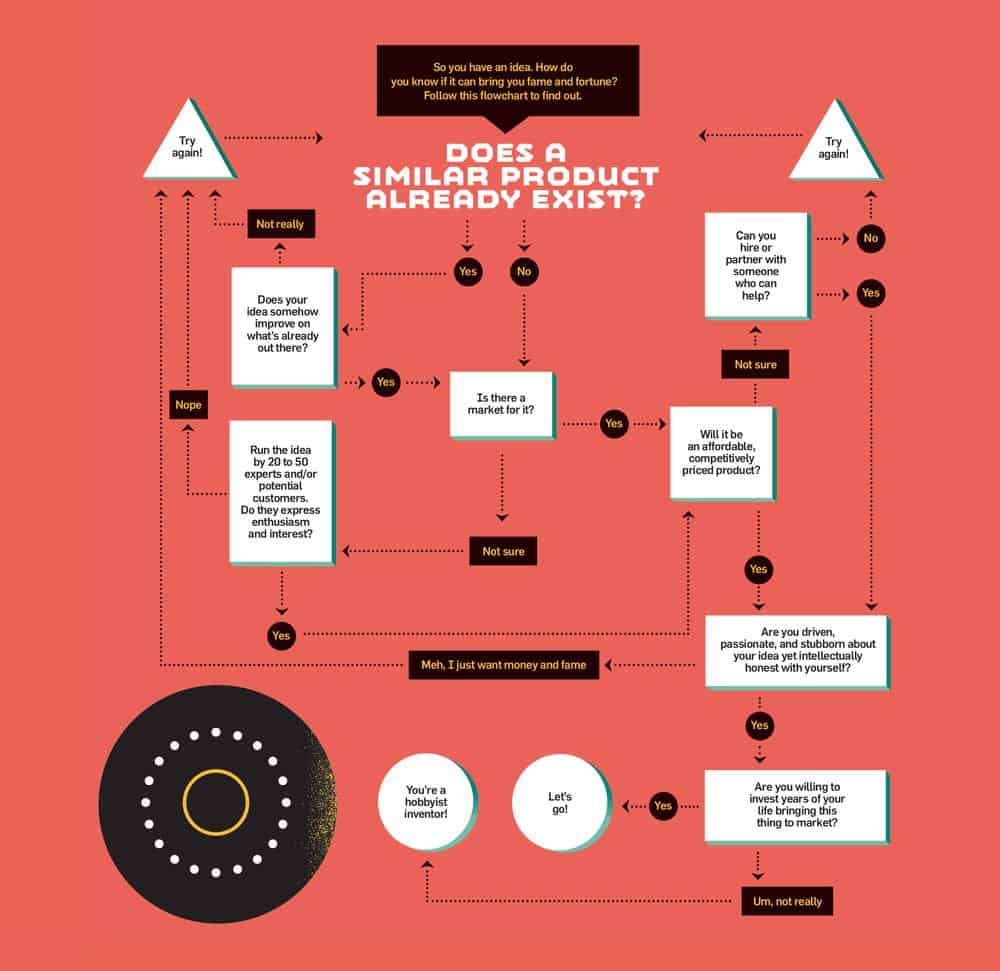
As a fun little exercise work through this flow chart

 Source: Popular Science, “Inventor’s Handbook” package , Illustrations by Doublenaut

Now a patent alone can be a huge part of a smart growth strategy, but I don’t want people to come away from this with any level of naiveté, a great patent can’t save or create a business. You might be able to effectively license a patent, but make sure you can really build a business around an idea by following the steps below before trying to get a patent.


How to Test An Idea Before You Try to Launch a Business, or Think about Patenting It

Step 1: Solidify Your Idea for an Invention

Hover boards. We all want hover boards.

It’s a great idea…but that’s all, it’s just an idea.

Let’s say you wanted to build as hover board. And you figured out how to make it work and power it without hassle. Now you could patent it here, but your work is still not done. How are you going to sell it? How will it charge? Will it fly or just hover?

I recommend that all inventors, and many of my friends, work through Peter Theil’s 7 Questions for Product Innovation framework. Before you get to excited. Ask yourself?:

  1. Can we build something 10X better than what is already there? i.e. will my new hover board be 10x better for consumers than existing skateboards? How about walking or biking, will it really be more convenient in a real way? Are there dangers I’m not thinking of?
  2. Is it the right time? Can my idea actually thrive in this market?
  3. Will I be able to “own” my market? If it’s easy for another billion dollar company in my market to make some minor changes, it’s probably not worth building
  4. Am I the right person to build this? and If not, do I know the people who can and would they?
  5. Can I distribute this? Do I know how I could actually sell this and get it to market.
  6. How durable is my idea? What will happen in 10 years when there could be hundreds of people selling something similar to my idea? Will customers still want to buy from me?
  7. Is there some secret magic here? Does your innovation uncover a secret, which solves a fundamental problem for the customer?

Peter Theil’s winner take all ideology might be too much for you, but a t a basic level think through your idea, and keep a list of your notes.

The gaol at this point is to just have a basic business plan or elevator pitch. Can you describe your product/idea in one sentence to your target customer? Would your grandma get it?

Some Further Questions:

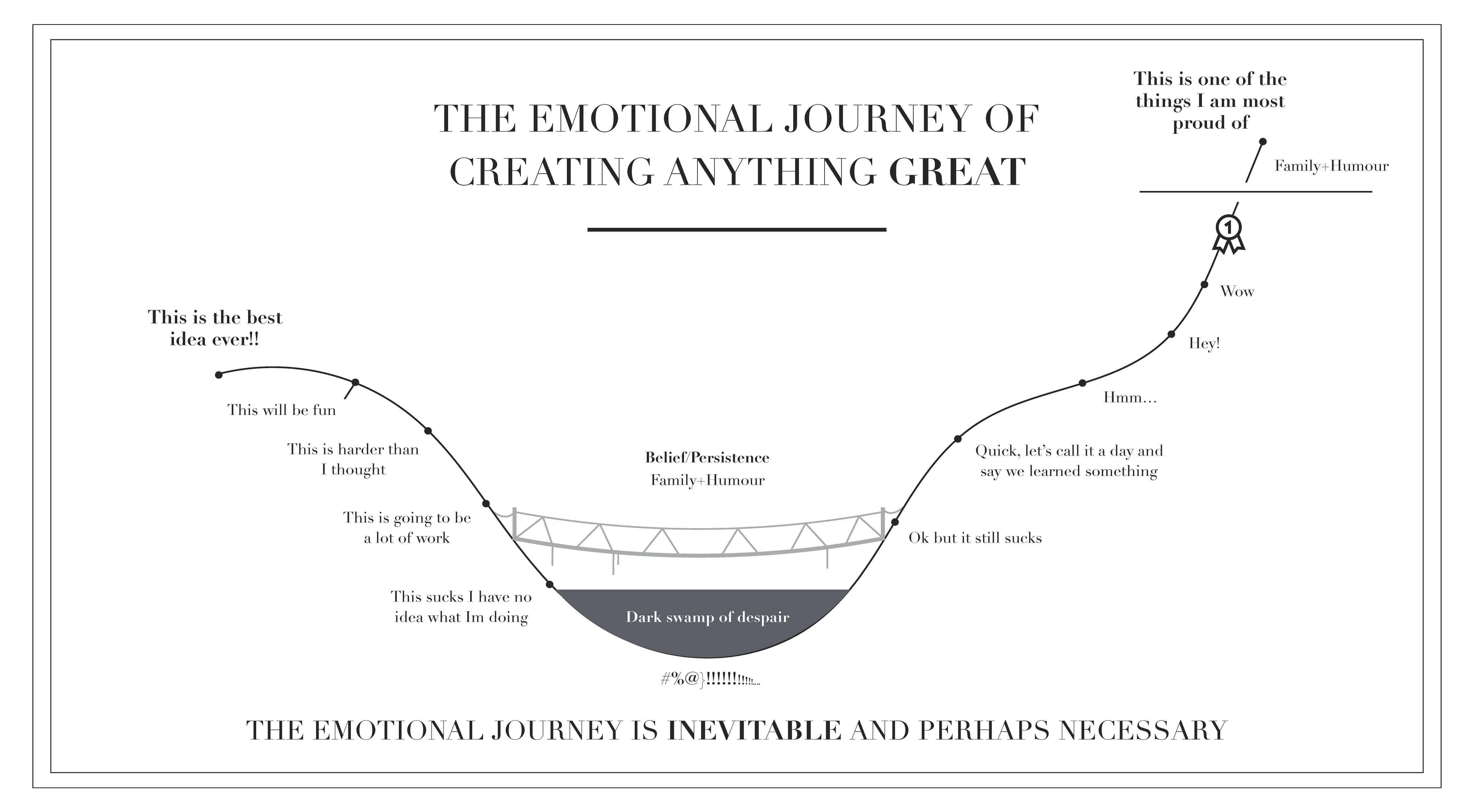
What’s your purpose? does this idea fulfill a dream you have a strong feeling towards? Being an entrepreneur is hard. It’s brutal and lonely.

 Source: John Saddington

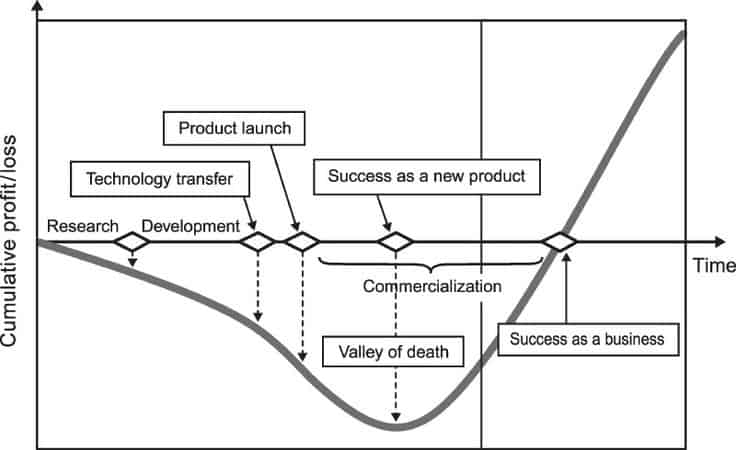
That big old chasm in the middle there, what is often referred to as the “Startup Valley of Death,” will take a lot of passion to get through.


  Source: Osawa and Miyazaki, 2006

 Be prepared for the reality that your idea might change as you progress through the steps outlined above.

Are you solving a real problem? If customers don’t know they have the problem you think they do, or they don’t quickly grasp why they want it, it’s probably not going to be an easy sell.

If there are people that have the problem, can you find them and talk to them?

Hopefully you had answers for all of the above questions. And that’s good, next, we need to check out the market.

Research the Market

The biggest hurdle will be if an invention already exists. Just because you haven’t heard of something it doesn’t mean that people aren’t already selling, or haven’t tried to sell it before. If it didn’t work for them there may be a good reason. I recommend doing a patent search and going through the “un-official” patent search method I’ve outlined in this how to for patent searches. Trying to locate similar products on the market can let you know what sorts of challenges might face your new invention.

Try to consider who would actually buy your product. Say you were inventing a new kind of water, well it’s hard to find any one person that really really wants it since we all need. But maybe you sell something that’s sports specific. Well, then like Gatorade, you know that you need to target athletes. go through the process of who would ultimately “buy” your idea and start to understand what and how those people shop.

Next, take some time.

Yeah really, take a bit of time. Process what’s out there. as Greg Isenberg, a venture capitalist and serial entrepreneur, said in a 2014 interview, After I’ve gone through the process of writing down a bunch of ideas, I don’t like to rush into building a business plan or recruiting the team,” Isenberg stated. “I like to wait a few weeks, [to] see which ideas really stick with me.” Taking this time before you jump head over heals will let you genuinely evaluate on a personal level if you’re still interested in the idea after the initial luster has faded.

Finally, start small. Create a Prototype or Build a Minimum Viable Product (MVP).

This is “the simplest form of your idea that you can actually sell as product,” said Eric Ries, a Silicon Valley-based entrepreneur and the author of “The Lean Startup” (Crown Business, 2011). Or as Reid Hoffman has put it:

 If you are not embarrassed by the first version of your product, you’ve launched too late.

Getting something simple out will let you gauge what other hurdles you might face, and actually have something tangible to show people.

Step 2 Get Validation

Don’t fear feedback. Good feedback will make your idea better.

The big thing witch gauging an ideas possibility of success is to always be open to feedback and to seek validation for your ideas. You need constant feedback to succeed. 

Now that we have an MVP we can actually test it on the market. There are multiple ways to do this, but basically you can test out your idea in a small way out in the wild and see how people would react.

  • Create a simple landing page, and send Ads to it. There are multiple routes you could take here, but I’ll just shoot your over to the brilliant Product Creation Masterclass from ConvertKit. It’s relatively easy to set up Facebook Ads, Reddit Ads, or plain old Adwords to get people looking at your “idea” in it’s final form. 
  • You could even get more intense and create a website and social media presence, building on the strategy outlined above. This is something you could show to friends, colleagues, and potential customers to gauge interest, heck, you could even take preorders.
  • Expose people to your site or landing page on User experience sites like Usability Hub. Do they get it?
  • Present your  MVP to friends and family. They may have heard your original idea, but what do they think of the “product” that creates. You can also look for Facebook Groups, or SubReddits that might be interested and try to show them your product.
  • Don’t forget to ask for help, or ask people for favors! If there are one or two individuals or communities you think would be perfect for your idea, consider “pitching” it to them. See if you can get them to use it and if it will stick. If they get excited and ask for more features than you probably have a great idea.
  • Meet people you don’t know! Now it’s important to be careful in more competative industries, but if you have an idea that you’re burning to get out there, theres nothing stopping you from reaching out to your potential customers in person. You’ll have to do it eventually no matter what, you might as well start early.
  • You could also run a Survey to see if people want or understand your thinking behind the product.

Step 3 Refine

Be ready to change. Any idea is going to get reinvented many times until it’s a successful invention. So long as you have done step 1 and 2 properly you should know how good in a position you are to monetize your invention, wether it can be a business, and when you should patent your idea.

Best of luck inventing!

Some ideas for being smart about sharing ideas!

You have to understand the risks. The above tactics are almost always necessary to test out how good an idea is, unless you’re already steeped in an industry. But people can copy ideas quick. There are horror stories out there like the selfie-stick KickStarter campaign that was copied and being sold before it even finished being funded. But risks are always going to be part of the challenge of inventing.

There are two strategies you can use to mitigate dangers, but at the end of the day you really can’t  protect yourself completely against bad actors, there are cheaters and scammers out there. That said nondisclosure or confidentiality agreements can be a good strategy to protect yourself from potential partners, investors, or distributors who might take your invention for their own.

Another option is to just file a provisional patent, until you have your idea and business model 100% dialed in.

Neither of the above two options are full-proof, but will offer you a bit more protection while your idea is developing in the wild.


The post I have a Great Idea?…So now what? 3 Steps to Take Before Getting a Patent appeared first on Amir Adibi Patent Lawyer.


source https://www.patentlawyer.io/great-idea-now-build-a-business/

2 Strategies for Patent Searches That’ll Save You Time Before You Try to File

So you had your brilliant stroke of genius? The invention that the world has always wanted, but didn’t know it needed hit you in the middle of the night like a thunderbolt and you thought to yourself, this is the one. 

We’ve all been there! Invention and reinvention is what America is all about. It’s that entrepreneurial spirit that makes this country so great. I’ve run through the same thought process described above more than a few times. And it’s a common scenario that I hear frequently on calls.

But not so fast, there are a few different factors to consider before you start dreaming about what upholstery pattern you’re going to get in your brand new jet. I’m not saying it can’t happen, but creating, patenting, and launching a successful invention is a huge task. It’s not as simple as just getting a patent, and even filing a patent itself is a complicated process.

In this article I’ll outline two strategies for filing a patent. This process wouldn’t be the same as someone charging for this service would do. But it should help you begin to gauge the uniqueness of your idea, before you attempt to go further in patenting your invention.

There are many successful inventors out there, but what many first time inventors don’t realize is that going from an idea to a successful product is a huge endeavor. Even if you haven’t heard of an idea, someone may have already patented it.

How to Start You Patent Search

Now let this serve as a disclaimer, doing a patent search is complicated. Many patent attorneys offer patent searches as a service, as do I, and there are even professionals and companies that specialize in it. Through years of experience every attorney will have their own process and favorite tools for patent searches. But it’s not just about digging into wether something has been done before, but how the entire scope of similar and related inventions might affect your filing and especially how examiners will look at that information.

In this article, I’ll lay out what you need to know about about the variety of resources out there that can aid in your patent search needs: how to access them, how to navigate them, and the pros and cons of each. I’ll begin this article by moving through the avenues laid out by the USPTO, and follow up by focusing on the top web tools for patent searches. The task of searching for a patent can seem daunting, but with the help of this article, you will have an understanding of how to get started.

The “Un-Official” Way to See if Your Invention has Been Patented

Here’s a basic process that I recommend to new inventors or entrepreneurs just trying to get a sense of the market. Getting excited about your idea is important, but making sure nothing has come before it is also important.

For starters:

  1. Brainstorm some basic terms that describe your invention. Think about what it does and how it does it, as well as the materials it’s made of, or how you’d describe something similar to it. These related terms can help you gauge wether your idea is already in existence somewhere else.
  2. Next do a basic search using Claim Parse or Google Patents While not the official route, either service should give you in depth information about the item your thinking of. A thorough search on either service should turn up any ideas similar to your own, especially if you did a good job coming up with terms in step #1.
  3.  If #2 turned up nothing look up the problem your idea is solving. By simply Googling a topic you might find a related product or solution that’s exactly what you’re proposing. Even Pinterest or Reddit could reveal wether something already exists. Generally anywhere people are having conversations about issues might help you find something similar to your idea.
  4. If step 3 turns up nothing I’d recommend searching sites like Amazon, The Grommet, KickStarter, Product Hunt and Indigogo. If your idea exists somewhere, it will probably be on one of these sites.
  5. If you do find you need to speak with a patent attorney to know for sure. But you can search the company name, or inventors name to see if they hold a patent on it.

Now if you find something in the above steps that looks similar to your idea it doesn’t mean it’s been patented, but it may also affect patentability. Again a patent search can only turn up so much unless you have the years of experienced required in patent law to really understand what the existing patent documents out there mean, and how patent examiners might interpret them.

The “Official” Way to Search for a Patent

Now why do I say official? Well for the first time inventor the below steps might be overkill. If you’re simply trying to figure out wether a product has been done before you reach out to an attorney then the “unofficial” process I describe above might be better. Now if you’re an experienced inventor or looking at something in the software of technology realm that’s more complicated, the below process will probably be necessary.

The USPTO website lays out a 7-step guide for running a preliminary patent search using their tools and tools of their European partner, the EPO. Their recommended approach focuses on patent classification searches. Their instructions help you brainstorm terms to search within USPTO website to determine your proposed patents potential Cooperative Patent Classification, and then instruct you in the use of various databases to search patents and patent applications that might legally cover your idea. Click to access the USPTO’s 7-step U.S. Patent search strategy guide handout or the associated computer based training tutorial CBT (computer based training) tutorial with a detailed review of the Seven Step Strategy.

The process is roughly as follows:

Step 1) Start by brainstorming specific terms that describe your invention. Work backwards from the problem it solves and how it’s made. Try to create a list of terms other people would use to describe its purpose and composition.

Step 2) Then Use these terms to find some relevant Cooperative Patent Classification patents. If you enter “CPC Scheme [plus keywords(s) describing invention]” into the search box you should begin to find related inventions. For example if you’re trying to patent a new kind of shoe, searching something like “CPC Scheme shoe” should show some relevant inventions. You could also

Step 3) You can than verify the quality of your search by reviewing the CPC Classifications definition linked to the patent you’ve found.

Step 4) You can then gather patent documents on the PatFT (Patents Full-Text and Image) database . From here you can narrow down the search terms you’re using by going through abstracts and looking at drawings to narrow your search further. Patterns should begin to emerge. At this point you might just find exactly what you were trying to patent, or something similar. Now that said, these things are still open to interpretation and it may still be worth speaking with a professional if you’re serious.

Step 5) Even if you don’t find a smoking a gun you should dig into each of the most related patents and gauge their similarity to yours. Looking at references cited by them or the patent examiner can be a boon for important related patents.

Step 6) Now retrieve published patent applications with the CPC classifications you chose in Step 3 using the AppFT (Applications Full-Text and Image) database. Use the same process I outlined above to narrow down your inventions.

Step 7) Finally broaden yours search to find any additional U.S. patent publications by searching related terms brainstormed in Step 1 within the PatFT, AppFT databases, and non-U.S. patents on the European Patent Office’s Worldwide Espacenet patent database. Finally double check the disclosure of inventions using the Patent and Trademark Resource Center. Since that will also affect your invention.

Here’s a full list of resources recommended by the USPTO, linked to their descriptions on the USPTO website:

Now, you can imagine how complicated the above can get…

It’s only a quick introduction, but the two methods I’ve outlined in this article should help get you started, and at a minimum help you identify if your exact idea has already been done.


The post 2 Strategies for Patent Searches That’ll Save You Time Before You Try to File appeared first on Amir Adibi Patent Lawyer.


source https://www.patentlawyer.io/how-to-search-patents/

Companies vs. Inventors: 8 Critical Things to Know About Patent Rights Ownership

In 2017, the United States Patent and Trademark Office (USPTO) issued 318,849 utility patents . Patent applications have increased by 5.2% ...